
Tesla's Flying Roadster Isn't a Product. It's a Belief Machine.
Tesla doesn't need the Roadster to sell cars. It needs the world watching when it tries something nobody else will.
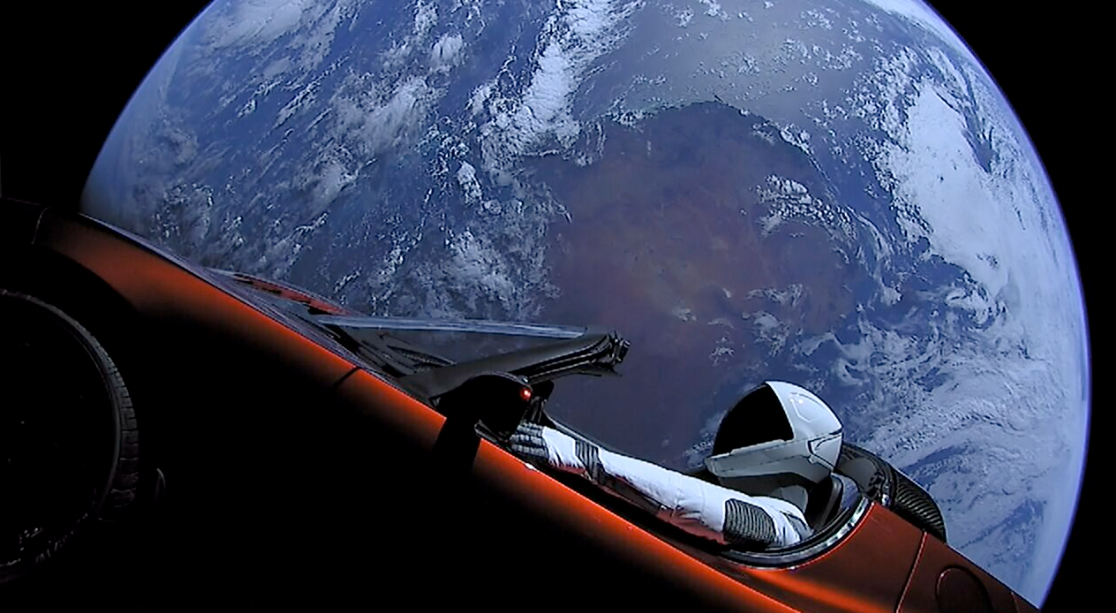
Tesla has officially confirmed a reveal event for its next-generation Roadster on October 1, in Waco, Texas, just up the road from SpaceX's rocket test site in McGregor. The teaser is nothing more than a countdown clock and three words: "Go for launch." I'll admit it, I've been checking that countdown more than I probably should. According to reporting ahead of the event, the car is expected to lift off the ground using cold-gas thrusters developed by SpaceX, operated remotely with no one inside, because the thrusters are reportedly loud and forceful enough to put spectators several hundred yards back. None of that has been confirmed by Tesla itself.
Worth being precise about what that means. The production Roadster itself is expected to be a street-legal car, the same premise that made the original 2008 Roadster notable. It's the SpaceX thruster package, the part everyone's actually excited about, that reportedly won't be. That version is expected to run as a demo only, likely sold in limited numbers for track use, not something you'll ever legally fire up on a public road. So no, it's not a flying car you or I will ever drive to work. And I still can't wait to see it.
There's something genuinely thrilling about a company willing to attempt something this hard, in public, with no guarantee it works. That's rare in big tech right now. Most companies ship the safe version and quietly shelve the ambitious one. This is the opposite instinct, and it's the kind of swing I find myself rooting for regardless of how it lands.
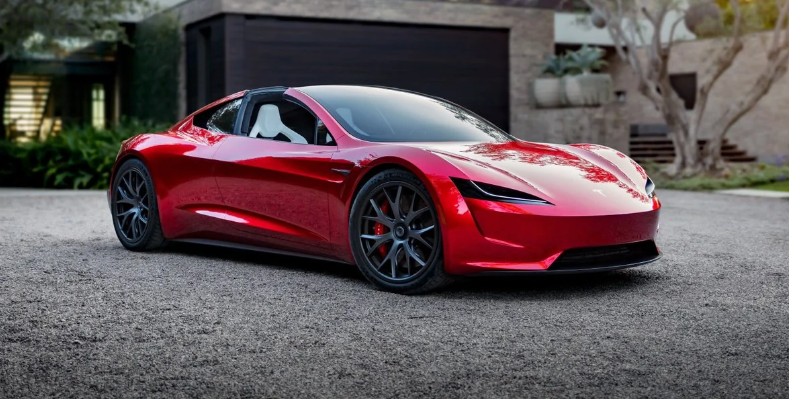
The Roadster has been the industry's longest-running unfulfilled promise, first teased back in 2017 with specs, a sub-two-second 0-60, a 250-plus mph top speed, 620 miles of range, that never made it to production. Nine years is a long time to keep a promise alive without breaking it entirely, and the fact that this thing is finally getting a real date on the calendar is, on its own, a small miracle of execution. Along the way, the design reportedly went through a Lamborghini Countach phase before the team pushed it toward something closer to the Lockheed SR-71 Blackbird, which is reportedly where the car's internal "A71" codename came from. Earlier concepts for the demo itself were even wilder, reportedly including the car launching up a magnetized ramp, flipping upside down mid-air, and righting itself, ambitions that appear to have been scaled back to something closer to a brief hover. Even the scaled-back version is, frankly, an incredible engineering flex.
Underneath the thruster spectacle, this is reportedly a genuine departure from how Tesla normally builds cars. Rather than stretching an existing platform, the team reportedly built the Roadster around an ultralight carbon fiber tub, the same construction approach used in top-end performance and race cars, a far more expensive and demanding path than reusing components already sitting on a production line. It's a two-seat car with butterfly doors, a completed prototype reportedly finished in late 2025, and a shape that's drifted over the years from something closer to a Lamborghini Countach toward the sharper, aerospace-inspired lines of the Lockheed SR-71 Blackbird. Selling it everywhere won't be simple either. A car this unconventional will likely need separate type approval in markets like the EU, and right-hand-drive markets add yet another layer of certification on top of that. None of it is the easy path. All of it is the interesting one.
A halo product doesn't have to work perfectly. It just has to prove the company can still try.
Here's the real strategy, and it's one I think more companies should study. This is a company borrowing aerospace engineering, built for an entirely different business, orbital rockets, to manufacture belief in a consumer brand at a moment when EV enthusiasm broadly has cooled and investor attention has drifted toward AI and robotics. A halo product doesn't need to be practical. It needs to be undeniable proof that the company is still capable of things nobody else is even attempting. And say what you want about how it lands on October 1, the fact that they're attempting it at all is the story I find most exciting.
I'd frame this as R&D spillover as marketing, not product strategy, and that's exactly why it works. It isn't a flying car business. It's a demonstration of what happens when a company has genuine cross-domain engineering to draw from, aerospace propulsion feeding automotive design, in a way almost nobody else in the industry can replicate. Whether the eventual demo reads as "visionary" or "spectacle" mostly depends on whether it delivers even a glimpse of what's promised, and history says these moments tend to land somewhere in between. I'll take that bet every time over a company that never attempts the moment at all.
The more interesting long-term question, to me, is what this signals about how vertically integrated tech conglomerates will compete going forward. Fewer companies are staying in a single lane. The ones with genuine cross-domain engineering, aerospace propulsion feeding automotive design, AI feeding robotics feeding automotive software, are the ones capable of producing moments like this one at all. That's a structural advantage that's hard to replicate and worth watching closely as a differentiator, independent of whether any single demo sticks the landing. Whatever happens on October 1, I'll be watching the livestream, if there is one, like it's a launch day.
It's worth remembering how rare this kind of moment actually is. Most product reveals in tech are incremental, a faster chip, a slightly better camera, a subscription tier nobody asked for. This is the opposite of that. It's a company betting a genuinely public moment on an engineering problem nobody has solved at consumer scale before, in front of an audience that will absolutely notice if it doesn't work. That kind of exposure takes real conviction, and regardless of how the thrusters perform on the day, I think there's something worth celebrating in a team still willing to put on a show like that instead of playing it safe.
"You don't have to build the future to convince people you're the one building it. You just have to show them a glimpse, and have the guts to try."
— Paul Gravette, Founder & CEO, Gravette Capital