

Stop Looking for One AI That Does Everything
The AI tools that pay you back are built for a job (unpaid invoices, missed calls, paperwork), not for a demo that claims to do it all. Here’s how to pick them, and what this week’s chip results quietly confirm.
By Paul Gravette · Entrepreneur ($3+ billion in sales from personally owned companies) | Private Equity | Family Office | Philanthropy
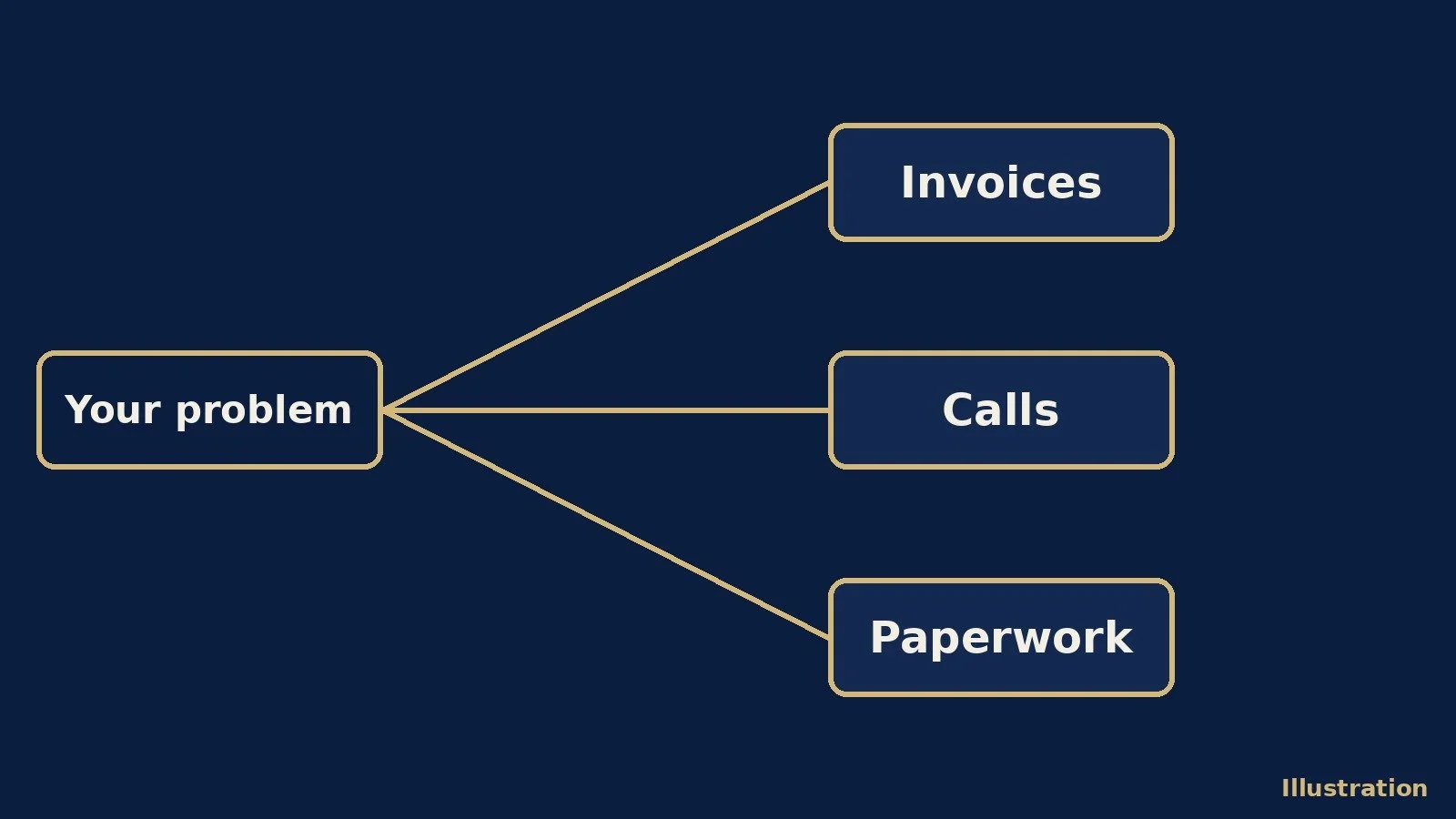
Stop looking for one AI that does everything. The tools that pay you back are the ones built for a specific job: chasing unpaid invoices, answering missed calls, clearing paperwork. You pick them the same way you’d pick a contractor: for the work in front of you.
Most owners I talk to are drowning in choices. A new “all-in-one” AI demo lands every week. You try one, it does okay at three things and poorly at the one you actually need, and you end up back in the spreadsheet. The fix is simpler than the marketing: match the tool to the problem.

One problem, one tool
Start with the job that is costing you money this month. If invoices are sitting unpaid, you need something that follows up until they get paid. If leads go cold after a missed call, you need something that answers and books the appointment. If paperwork is the bottleneck, you need a prompt and a checklist you can run this weekend, not another platform to learn.
Here is the quickest filter I know: describe what the tool does in one sentence without using the word “AI.” If the sentence is still worth paying for (“it chases late invoices until they clear” or “it answers missed calls within a minute”), good. If it falls apart into “it transforms your workflow,” keep looking.
That habit is how we look at deals at Gravette Capital, and it is the same habit behind $3+ billion in sales from personally owned companies. You do not need a PhD in models. You need a clear problem, a small test, and a clean exit if it does not pay you back.
Why “specialists” is practical advice
The same idea showed up in public this month as “independence and specialization.” On October 3, Andreessen Horowitz (a16z) posted about an episode Erik Torenberg hosted “on why the future of AI is independence and specialization.”1 That framing is a16z’s. The guests made the practical case.
Alex Atallah of OpenRouter, in Stripe’s August 19 announcement that it agreed to acquire OpenRouter, put it in one sentence: “We believe intelligence will be multi-model: no single model will be optimal for every task, and developers need a neutral layer to orchestrate and manage them all.”2 OpenRouter is a model router: a switchboard that sends each request to whichever model fits the job on task, price, speed and reliability. Stripe said it routes across more than 400 models from more than 80 providers.2 a16z’s summary of the episode also quotes Atallah arguing that “10 specialized chiefs of staff beats one superagent.”1
My takeaway for a small business is not the podcast jargon. It is this: stop hunting for one subscription that does everything, and start matching tools to jobs. Grok 4.7 is available through the Grok API and through model routers and cloud platforms, which fits that pattern. Pick the model that fits the task, not the one with the loudest launch.3
Illustration
What the chip results said this week
If AI work is spreading across many tools and many companies, demand for the chips underneath should stay broad, not sit in one lab. The two biggest names in that stack reported results this week. Treat the numbers as context, not as a forecast of your inbox.
ASML, which builds the lithography machines that print advanced chips, reported third-quarter 2026 results on October 14: total net sales of €11.7 billion, a gross margin of 57.5%, and net income of €5.0 billion. CEO Christophe Fouquet said customers are expressing interest in orders for 2029 and even 2030, driven primarily by their views on the size and duration of AI-related investments, and that ASML is investigating ways to increase capacity for 2028. For the fourth quarter, ASML guided total net sales between €14.2 billion and €15.2 billion with a gross margin around 57%. Full-year 2026 total net sales are expected between €44 billion and €45 billion, with a gross margin around 56%.4
TSMC, the largest contract chip maker, reported third-quarter 2026 results on October 15: net revenue of US$46.72 billion, beating its prior guidance range of $44.6 billion to $45.8 billion, with a gross margin of 66.4% and an operating margin of 58.7%. For the fourth quarter, TSMC guided net revenue of US$52.3 billion to $54.3 billion, a gross margin of 65% to 67%, and an operating margin of 56.5% to 58.5%.5
Those are company-reported figures from primary releases. They do not tell you which AI tool to buy. They do say the demand underneath this market is still wide. That fits a world of many specialists better than a world of one giant model.
What to do with it
You do not need one AI that does everything. You need the right tool for the invoice that has not been paid, the call you missed, and the paperwork still sitting on your desk. Pick by the job, test small, keep what pays you back, and use the time you win to engineer your future and grow into 2030.
"Stop hunting for one AI that does everything. Match the tool to the job, and keep what pays you back."
— Paul
Try this this week
Fix late payments first. If unpaid invoices are the problem, open Invoice Chaser (https://www.paulgravette.com/invoice-chaser) and see how a job-specific tool approaches follow-up.
Put a number on missed calls. If leads are slipping, run the free Speed-to-Lead calculator (https://www.paulgravette.com/speed-to-lead) to estimate what slow replies may be costing you each month.
Do one small test for free. Pick a real task and try a prompt from Try It This Weekend (https://www.paulgravette.com/try-it-this-weekend), then check the answer before you act on it.
Disclaimer: This article is for general information and education only. It is not financial, investment, legal or tax advice, and it is not an endorsement of any product or security, including shares of any company named here. AI tools can make mistakes; review their output before you rely on it, especially for anything involving money, law or health. Company figures (ASML, TSMC, Stripe, xAI) are as published by those companies and were not independently audited for this draft. Forward-looking guidance from ASML and TSMC is subject to change. Quotes and views attributed to Alex Atallah, a16z and others are their own. Invoice Chaser, the Speed-to-Lead calculator and Try It This Weekend are pages on PaulGravette.com. Invoice Chaser is a tool being built by Paul Gravette's own team, with paid plans planned. No links in this article are affiliate links.
Sources
a16z on X, Oct. 3, 2026: https://x.com/a16z/status/2106408584460509308 (episode framing “independence and specialization”; Atallah “10 specialized chiefs of staff” summary)
Stripe newsroom, “Stripe agrees to acquire OpenRouter,” Aug. 19, 2026: https://stripe.com/newsroom/news/stripe-agrees-to-acquire-openrouter (Atallah multi-model quote; 400+ models, 80+ providers)
xAI, “Introducing Grok 4.7”: https://x.ai/news/grok-4-7 (availability via Grok API, model routers and cloud platforms)
ASML Holding N.V., Q3 2026 financial results press release, Oct. 14, 2026 (SEC EDGAR): https://www.sec.gov/Archives/edgar/data/937966/000162828026065813/pressreleasefinancialresul.htm (€11.7B sales, 57.5% GM, €5.0B net income; Q4 and FY guidance; Fouquet customer-orders and capacity comments)
TSMC Investor Relations, 2026 Q3 quarterly results: https://investor.tsmc.com/english/quarterly-results/2026/q3 (US$46.72B revenue vs prior guidance $44.6–45.8B; GM 66.4%; OM 58.7%; Q4 guidance US$52.3–54.3B, GM 65–67%, OM 56.5–58.5%)